
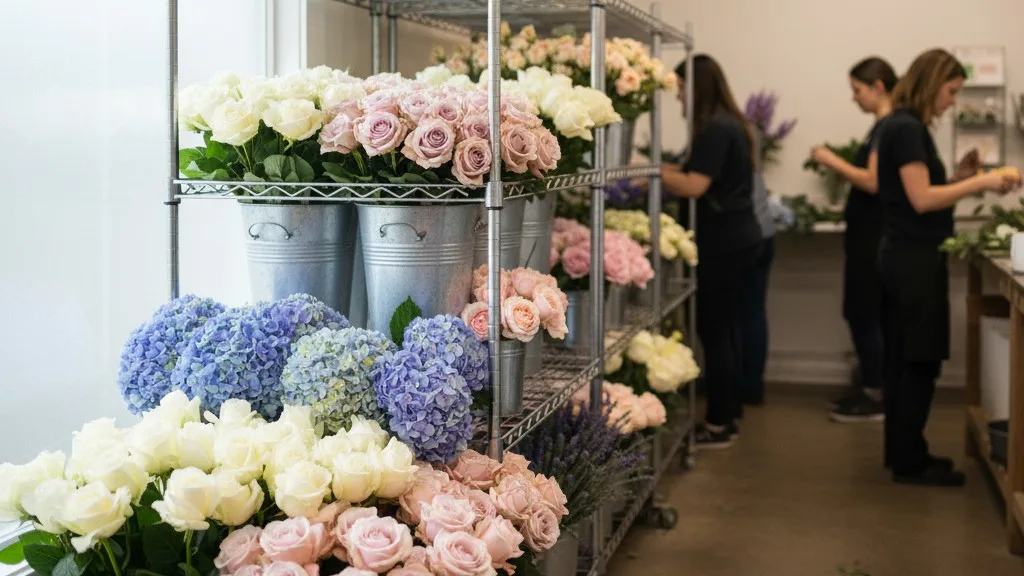
Knowing what's in your cooler and on your shelves is the difference between profit and loss. For a flower shop, inventory is a constant, moving target of perishable flowers, hard goods, and supplies. This guide provides a complete system for florist inventory management, helping you reduce waste, price accurately, and make smarter purchasing decisions.
Why Manual Inventory Tracking Fails Flower Shops
If you're still relying on clipboards, notebooks, or even a collection of spreadsheets, you're likely feeling the strain. While these methods might work for a time, they create hidden costs and operational drag as your shop gets busier. Manual inventory tracking simply can't keep up with the unique demands of a floral business.
The most common manual method, the spreadsheet, is often the first sign of trouble. It's a tool many people know, but it quickly becomes a bottleneck. Data entry is slow and prone to errors, and it's nearly impossible to keep a single, up-to-date version that everyone on your team can access. When a designer pulls flowers for an arrangement, does they remember to update the master spreadsheet? Usually not, which means your data is always out of date. If this sounds familiar, you may be experiencing the signs that your flower shop has outgrown spreadsheets.
Unlike a business selling non-perishable goods, a florist's core product has a strict expiration date. A rose stem that isn't sold or used within a few days becomes a total loss. Manual systems lack the speed and automation to effectively manage this cycle. Without a clear, real-time view of what's aging in the cooler, it's difficult to enforce a "first-in, first-out" (FIFO) policy, leading to unnecessary waste.
Floristry is also about transformation. You don't just sell stems; you sell arrangements. A single arrangement recipe might include specific flowers, a vase, floral foam, ribbon, and an enclosure card. Manually calculating the true cost of that arrangement and deducting all the component parts from inventory for every single order is complex and time-consuming. Most shops simply give up, leading to a major blind spot in their financial picture.
When you don't have accurate data, you're forced to rely on guesswork for your purchasing. This leads to two expensive outcomes: you either overbuy to be safe, resulting in spoiled flowers and wasted money, or you underbuy and miss out on sales or have to make last-minute, high-cost trips to the wholesaler. Both scenarios eat directly into your profit margins.
What to Track: A Complete Flower Shop Inventory List
Effective florist inventory management requires tracking everything that goes into your products and operations. Breaking your inventory into distinct categories makes the process more manageable and ensures you don't overlook hidden costs. A good system should account for every item that contributes to the final cost of an arrangement.

Fresh Flowers (Live Goods)
This is the heart of your inventory and the most critical category to track. Your system should allow you to log flowers by the unit you purchase them in (stems, bunches, or boxes) and the unit you use them in. For each entry, you should record:
- Item Name and Variety: E.g., Rose, Freedom; Hydrangea, White; Gypsophila, Million Star.
- Unit of Measure: Stem, bunch, box.
- Quantity Received: The number of units you purchased.
- Cost per Unit: The price you paid the wholesaler for each stem or bunch.
- Supplier: Which vendor you purchased from.
- Date of Arrival: This is essential for implementing a FIFO system.
Tracking this information allows you to see not just what you have, but how old it is, what you paid for it, and how many you've used. This data is the foundation for accurate recipe costing and waste analysis.
Hard Goods (Vases, Containers, and Mechanics)
These are the non-perishable, reusable, or foundational items that give your arrangements structure and form. They represent a significant investment and must be tracked to ensure accurate pricing and availability, especially for holidays. Your hard goods inventory should include:
- Vases and Containers: Glass vases of all shapes and sizes, ceramic pots, baskets, and metal containers. A good system lets you see exactly how many 8-inch cylinder vases you have on hand.
- Floral Foam: Bricks, cages, and specialty shapes for both fresh and permanent botanicals.
- Mechanics: Tools of the trade like floral wire, waterproof tape, water tubes, and grid systems.
Forgetting to add the cost of a $15 vase to an arrangement's price is a common and costly mistake. A robust inventory system connects these items directly to your product recipes, ensuring their cost is always included.
Supplies and Consumables
These are the items that finish an arrangement or support the sales process. While individually inexpensive, their costs add up substantially over a year. Failing to track them means you're giving away a portion of your profit on every sale.
- Finishing Touches: Ribbon, tissue paper, cellophane, decorative picks, and enclosure cards.
- Shop Supplies: Flower food, finishing spray, cardettes, and delivery tags.
- Giftware: Non-floral items you sell, such as candles, chocolates, greeting cards, or stuffed animals.
By adding these items to your inventory system with their associated costs, you can build them into your pricing formulas, ensuring every component of a sale is accounted for.
Setting Up Your Florist Inventory Management System
Transitioning from a manual method to a structured system requires planning. The goal is to create a process that is accurate, repeatable, and easy for your entire team to follow. This is where dedicated flower shop software becomes indispensable, as it's built for this specific workflow.
Step 1: Choose Your Tool
While you can attempt to build a more complex spreadsheet system, this approach often fails for the same reasons a simple list does. A dedicated florist point-of-sale (POS) system with integrated inventory management is the most effective solution. These systems are designed to handle the complexities of recipes, perishability, and multi-component orders. Orkyd, for example, allows you to manage fresh flowers, hard goods, and supplies in one place, linking them directly to your product recipes and sales data.
Step 2: The Initial Count
This is the most labor-intensive part of the process, but it only needs to be done once. You must perform a full physical count of everything in your shop. Go through your coolers, stockroom, and sales floor with a clear plan.
- Schedule a time: Plan the count for a slow day or after hours to minimize interruptions.
- Work in teams: Have one person count and another record the numbers directly into the new system or on a prepared sheet.
- Be systematic: Go shelf by shelf, cooler by cooler. Mark areas as