Funeral flower delivery is one of the most important services your shop provides. These orders are time-sensitive, emotionally significant, and leave no room for error. A flawed process can lead to stressed staff, wasted product, and a painful experience for a grieving family. Creating a reliable system for coordinating funeral flowers ensures that every arrangement arrives at the right place, at the right time, and serves its purpose of offering comfort.
This guide walks through a complete workflow for handling funeral flower deliveries with the precision and care they require. By standardizing your process from order intake to post-delivery confirmation, you can manage these critical orders efficiently and compassionately, even on the busiest days.
The Foundation: Gathering Complete and Accurate Information
The entire funeral delivery process depends on the quality of information you collect when the order is placed. Small inaccuracies at this stage can cause significant problems later. The goal is to capture every necessary detail upfront to prevent last-minute scrambling and potential mistakes.
When a customer calls or comes in to place a sympathy order, your staff should follow a consistent checklist. Train your team to be patient and thorough, as the person placing the order is often distressed and may not know all the details.
What to Ask for Every Funeral Order
Create a standard intake form or a required field set in your point-of-sale system. It should include:
- Full Name of the Deceased: Get the complete name and ask for the spelling. It's also helpful to ask for a common nickname, as this can help funeral home staff identify the correct service.
- Name and Address of the Service Location: This could be a funeral home, church, event center, or private residence. Get the full street address, city, and zip code.
- Date and Time of All Services: This is the most critical detail. You need to know the times for the visitation or viewing, the funeral or memorial service, and any graveside committal. Flowers must arrive before the first scheduled event where the public will be present.
- Specific Delivery Instructions: Ask the funeral home about their preferred delivery entrance (e.g., a back door, a loading dock) and any specific drop-off times they require.
- Card Message: Read the message back to the customer to confirm the content and the signature line (e.g., "The Smith Family," "John and Jane Doe").
- Customer Contact Information: Get a reliable phone number and email address for the sender in case you have any questions or need to confirm information.
Never assume the customer's information is complete or correct. Grieving families sometimes change service times or locations, and friends or colleagues may have second-hand details. Your shop's policy should be to independently verify all service information.
The Verification Call: Your Most Important Step
As soon as the order is placed, a designated staff member must call the funeral home or service venue directly. This single step prevents the vast majority of funeral delivery errors. During this call, you should:
- Confirm the Deceased's Name: State the name you have and confirm it matches their records for an upcoming service.
- Verify All Service Times and Locations: Say, "We have the viewing scheduled for Friday from 6 PM to 8 PM and the funeral service on Saturday at 10 AM. Is that correct?" This confirms the details and gives them a chance to provide updated information.
- Inquire About Other Family Tributes: Ask if the family has provided specific guidance on flowers. Some families request donations in lieu of flowers, or they may have a specific color scheme coordinated with the funeral director. Knowing this allows you to guide other customers who may call to order for the same service.
- Establish a Delivery Window: Ask the funeral director, "What is the best time for our driver to deliver the flowers on Saturday morning?" They can tell you when staff will be on-site and when the casket or urn will be in place, ensuring your arrangements are part of the initial setup.
This verification call is a professional courtesy that funeral directors appreciate. It shows that your shop is detail-oriented and helps their services run more smoothly. It builds a relationship of trust that can lead to direct referrals. Many funeral homes use specialized software to manage their cases; for example, shops using Orkyd can receive orders directly from funeral homes that use the connected Kindred management system, streamlining this communication even further.
In the Workroom: Preparing Funeral Arrangements for Success
Once an order is confirmed, the details need to be clearly communicated to your design and delivery teams. A chaotic order ticket or verbal-only instructions can lead to mistakes. The goal is to create a physical and digital paper trail that follows the arrangement from the design bench to the funeral home.

Use a system of clear, bold labels. Every funeral piece should have a tag that includes the deceased's name, the service location, and the delivery date and time. This prevents a beautiful casket spray intended for one service from being sent to another. For shops with high volume, consider color-coding tags by delivery day or funeral home to make sorting faster.
Designing for Stability and Transport
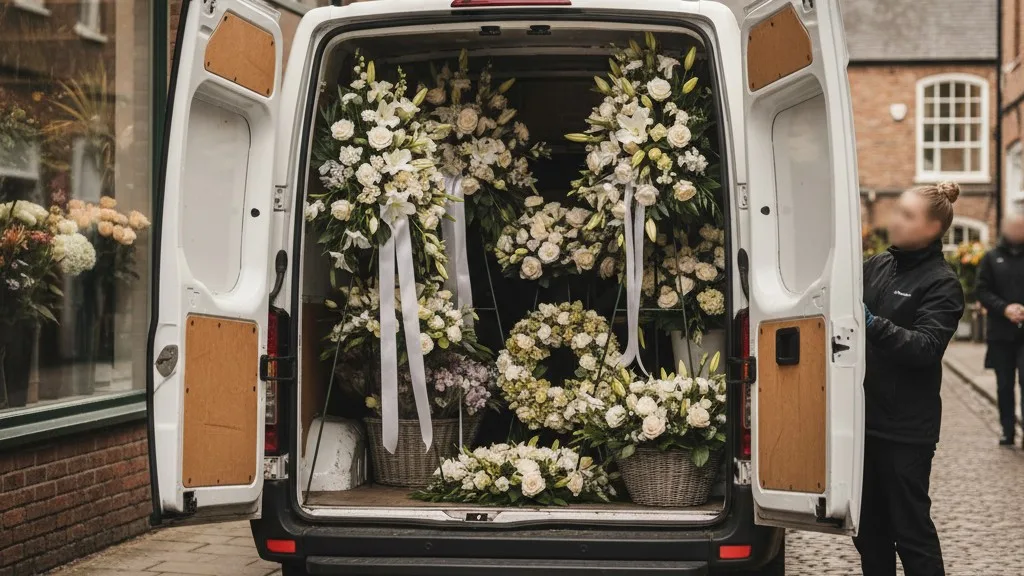
Funeral arrangements are often large and need to withstand a trip in a delivery van and being moved around at the service location. Designers should build with stability in mind.
- Secure Mechanics: Ensure all foam is securely caged and taped. For standing sprays, make sure the easel is sturdy and properly attached. Double-check that all elements are firmly in place.
- Hydration: Use fully saturated foam and ensure all stems are properly seated in the water source. Large arrangements can dry out quickly under warm lights at a funeral home.
- Finishing Touches: Attach the enclosure card securely but discreetly. A common method is to use a clear plastic pick with a fork or clamp that holds the card. Make sure the "From" line is clearly visible. For arrangements with banners or script, confirm the spelling and placement one last time before it leaves the workroom.
The final check before an arrangement goes out the door is crucial. The person in charge of delivery prep should have the original order ticket in hand. They should verify that the final piece matches the order description, that the card message is correct and attached, and that the delivery tag is accurate. This quality control step is your last chance to catch an error before it becomes a problem for the customer.
Staging and Routing: The Logistics of Funeral Delivery
Managing the logistics of funeral flower delivery requires a dedicated space and a clear plan, especially when you have multiple services on the same day. The goal is to stage, route, and load arrangements in a way that minimizes handling and confusion.
Creating a Dedicated Staging Area
Designate a specific area in your shop for completed funeral orders. This could be a section of your cooler or a corner of the shipping area. This space should be organized and clearly marked. As arrangements are finished, move them to this area. Group all pieces for the same service together. For example, all arrangements for the "Smith" service should be in one group, and all for the "Jones" service in another.
This visual organization helps everyone on the team see what is ready and what is still in production. It also makes loading much more efficient. Your driver isn't searching the entire cooler for a missing piece; they can see at a glance if the Smith casket spray is grouped with the two matching standing sprays.
Planning the Delivery Route
Routing for funerals is different from routing for daily residential deliveries. It's dictated by service times, not geographic efficiency. A funeral delivery at a 10 AM service takes priority over a birthday delivery that can arrive anytime in the afternoon.
Start by listing all funeral deliveries for the day, ordered by their required arrival time. Use this to build your route. A driver may need to go to a funeral home on the north side of town for a 9 AM drop-off, then cross town for a 10:30 AM delivery at a church. This might seem inefficient, but for funerals, timing is everything.
Provide your driver with a detailed route sheet for each trip. This sheet should include:
- The name of the deceased for each delivery.
- The full address of the service location.
- The designated delivery window confirmed with the venue.
- The name and phone number of a contact person at the venue.
- A complete list of all arrangements to be delivered to that location (e.g., 1x Casket Spray, 2x Standing Sprays, 1x Vase Arrangement).
Using modern flower shop software can make this much easier. A good system allows you to generate route lists and delivery manifests directly from your orders, ensuring the driver has all the correct information on a phone or tablet.
The Final Mile: Professionalism at the Delivery Location
The driver's conduct at the funeral home reflects on your entire business. A professional, respectful, and efficient drop-off reinforces your shop's reputation for quality service. This is not the time for a rushed or careless delivery.
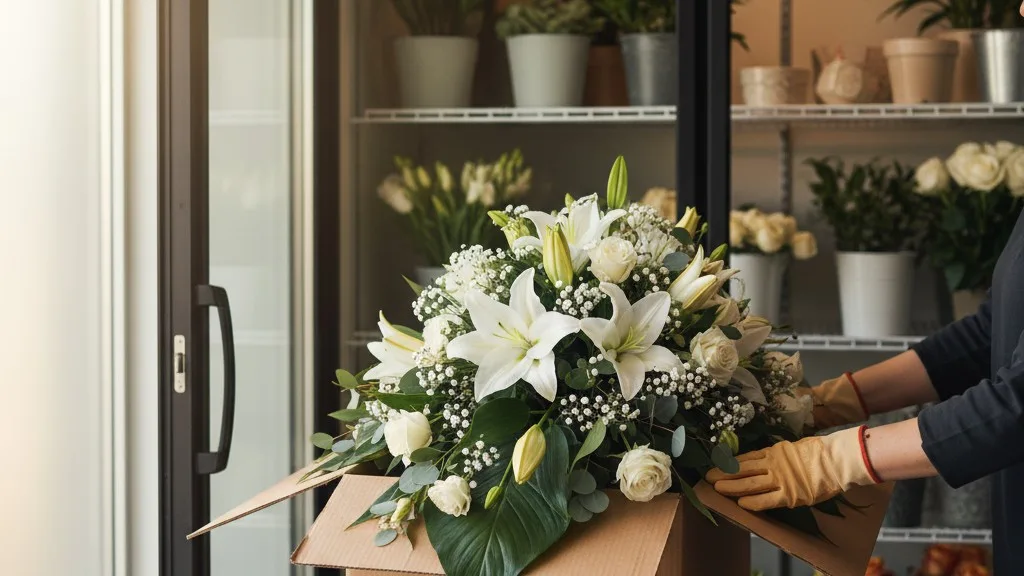
Train your drivers on funeral home etiquette. They should enter through the designated delivery door, if one was specified. They should be dressed neatly and maintain a quiet, respectful demeanor. The atmosphere inside a funeral home is one of somber reflection, and your staff should honor that.
The Drop-off and Placement Process
Upon arrival, the driver should find a funeral home employee. The first words should be, "I have the flower delivery for the Smith service." This immediately clarifies their purpose.
The driver should work with the funeral home staff to place the arrangements. The staff will know where the family wants flowers positioned. This may involve placing the casket spray on the casket, arranging standing sprays around it, and setting smaller arrangements on designated tables. Your driver should assist with this process as directed by the funeral home staff. They should never assume where things go.
Before leaving, the driver should do a quick visual check of all the pieces they delivered. Are the arrangements stable? Do any of them need a slight adjustment? This is the final moment of quality control. They should also get a signature or verbal confirmation from a staff member confirming that all pieces were received in good condition. This can be a simple note on the delivery manifest, such as "All received by Robert at 9:15 AM." This creates a record of a successful delivery.
Handling Common Funeral Delivery Challenges
Even with a perfect system, challenges will arise. Last-minute order changes, multiple services at one venue, and deliveries to private residences all require specific handling.
Last-Minute Orders and Changes
A customer may call the morning of a service asking for an arrangement. Be honest about what is possible. You may not be able to create a large, intricate spray, but you might be able to send a beautiful vase arrangement. If a family member calls to change a service time, your first action should be to call the funeral home to verify the change before altering your production schedule.
Multiple Services at One Location
It's common for a large church or funeral home to host multiple services on the same day. This is where your clear labeling system becomes essential. When your driver arrives, they need to be explicit: "I have flowers for the Smith service in the main chapel and flowers for the Jones service in the family room." Meticulous tagging prevents arrangements from ending up in the wrong room.
Deliveries to the Family's Home
Sometimes, customers want to send flowers directly to the family's home instead of the funeral service. These orders require a different approach. You should always call the recipient before attempting delivery to ensure someone will be home to receive the flowers. This avoids leaving a sympathy arrangement on a doorstep. For more guidance on this topic, consult our florist's guide to sympathy flower etiquette, which details the differences between sending flowers to the service versus the home.
Closing the Loop: Post-Delivery Confirmation and Record Keeping
Your job isn't finished when the van returns to the shop. Closing the loop confirms the successful completion of the order and updates your records for future reference. This final step is an important part of providing a complete and professional service.
The driver should check in with the office manager or person in charge of deliveries upon their return. They should turn in their signed delivery manifests, which should then be attached to the corresponding orders in your system. The order status should be updated from "Out for Delivery" to "Delivered."
This creates a permanent record that the order was fulfilled as promised. If a customer ever questions a delivery, you can pull up the order and say with confidence, "Yes, our records show the arrangement was delivered at 9:15 AM on Saturday and received by Robert at the funeral home." This level of detail demonstrates professionalism and protects your shop.
Keeping detailed records also helps you provide better service in the future. When a family has a positive experience with your shop during a difficult time, they will remember you for future occasions, both happy and sad. Your detailed customer history allows you to reference past preferences and provide thoughtful, personalized service for years to come. This is a key part of building a sustainable flower shop based on lasting relationships.
A System You Can Trust
Coordinating funeral flower deliveries is a zero-mistake game. By implementing a rigorous system for information gathering, verification, production, and delivery, you can remove the guesswork and anxiety from the process. A clear, repeatable workflow empowers your team to handle these sensitive orders with the grace and professionalism they demand, ensuring that your flowers always deliver a message of comfort, right when and where it's needed most.
A dedicated flower shop POS like Orkyd is built to support this detailed workflow, with features for managing complex delivery schedules, generating route lists, and maintaining detailed customer histories. If your current system makes this process harder, not easier, we invite you to book a conversation to see how software designed for a real flower shop can help.